Part of an Eight-Chapter Series
This article is one of eight exploring the clinical trial science behind pediatric and adolescent obesity medicine, written by Signant Health’s clinical scientists and regulatory specialists.

Any sponsor moving an anti-obesity medicine (AOM) from adults toward pediatric use eventually runs into the same regulatory question, answered differently on each side of the Atlantic: what must happen before this drug can be studied in children? In the United States, that question is governed by the Pediatric Research Equity Act (PREA); in the European Union, by the Pediatric Investigation Plan (PIP) process. Both systems make pediatric planning mandatory rather than optional, but they operate on different timelines, through different reviewing bodies, and with different routes to waiver, deferral, and incentive. As of January 2025, FDA has also set out, for the first time in real detail, what it expects a pediatric obesity trial to look like. This piece maps that regulatory architecture for regulatory affairs and clinical development teams building or refining a pediatric AOM program.
The central takeaway is straightforward: pediatric AOM strategy now needs to be planned as an integrated US-EU regulatory program, not as a late-stage add-on after adult development is substantially complete.
This territory is acronym-dense, so a short glossary follows before we get into the detail.
AOM – Anti-obesity medicine
PREA – Pediatric Research Equity Act (United States); mandatory Pediatric assessment requirement
BPCA – Best Pharmaceuticals for Children Act (United States); voluntary Pediatric study incentive
iPSP – Initial Pediatric Study Plan, the document a sponsor submits to FDA
NDA / BLA – New Drug Application / Biologics License Application, the U.S. marketing application
PIP – Pediatric Investigation Plan (European Union); the EU’s counterpart to PREA
PDCO – Pediatric Committee, the European Medicines Agency body that assesses PIPs
MAA – Marketing Authorisation Application, the EU’s marketing application
SPC – Supplementary Protection Certificate; the EU’s patent-linked exclusivity extension
DXA – Dual-energy X-ray absorptiometry, a body-composition scan
AAP CPG – American Academy of Pediatrics Clinical Practice Guideline (2023), referenced later in this piece
In the United States, PREA requires sponsors to conduct pediatric assessments when a new active ingredient, indication, dosage form, dosing regimen, or route of administration is submitted for a disease or condition that occurs in both adults and children, unless the assessment is waived or deferred. PREA applies only to the specific indication under review, and orphan-designated products are generally exempt (except in oncology). An initial Pediatric Study Plan (iPSP) must be submitted no later than 60 calendar days after the end-of-phase-2 meeting, and agreement with FDA must be reached before the NDA or BLA is submitted.
PREA has a voluntary counterpart, the Best Pharmaceuticals for Children Act (BPCA). PREA is mandatory and applies only to the specific indication under review; BPCA is voluntary and broader, because FDA can issue a written request covering the entire active moiety, including unapproved or different indications, in exchange for six additional months of marketing exclusivity. Historically, a sponsor could satisfy a PREA requirement while also holding a BPCA written request that included the same or related pediatric studies, although FDA’s more recent draft position may narrow that overlap.
The EU takes a structurally similar but procedurally distinct path. Regulation (EC) No 1901/2006 established the Pediatric Committee (PDCO) at the European Medicines Agency and requires a Pediatric Investigation Plan (PIP), covering the whole product rather than just one indication, to be agreed with the PDCO before a marketing authorization application (MAA) can be validated, unless a waiver or deferral applies. Article 16 sets the submission deadline at “not later than upon completion of the human pharmacokinetic studies in adults,” generally around the end of Phase 1, markedly earlier than PREA’s post-Phase-2 iPSP timing.
Compliant PIPs earn their own incentive: a six-month extension to the product’s Supplementary Protection Certificate (SPC), functionally parallel to BPCA’s exclusivity extension, though tied to patent-linked protection rather than FDA exclusivity.
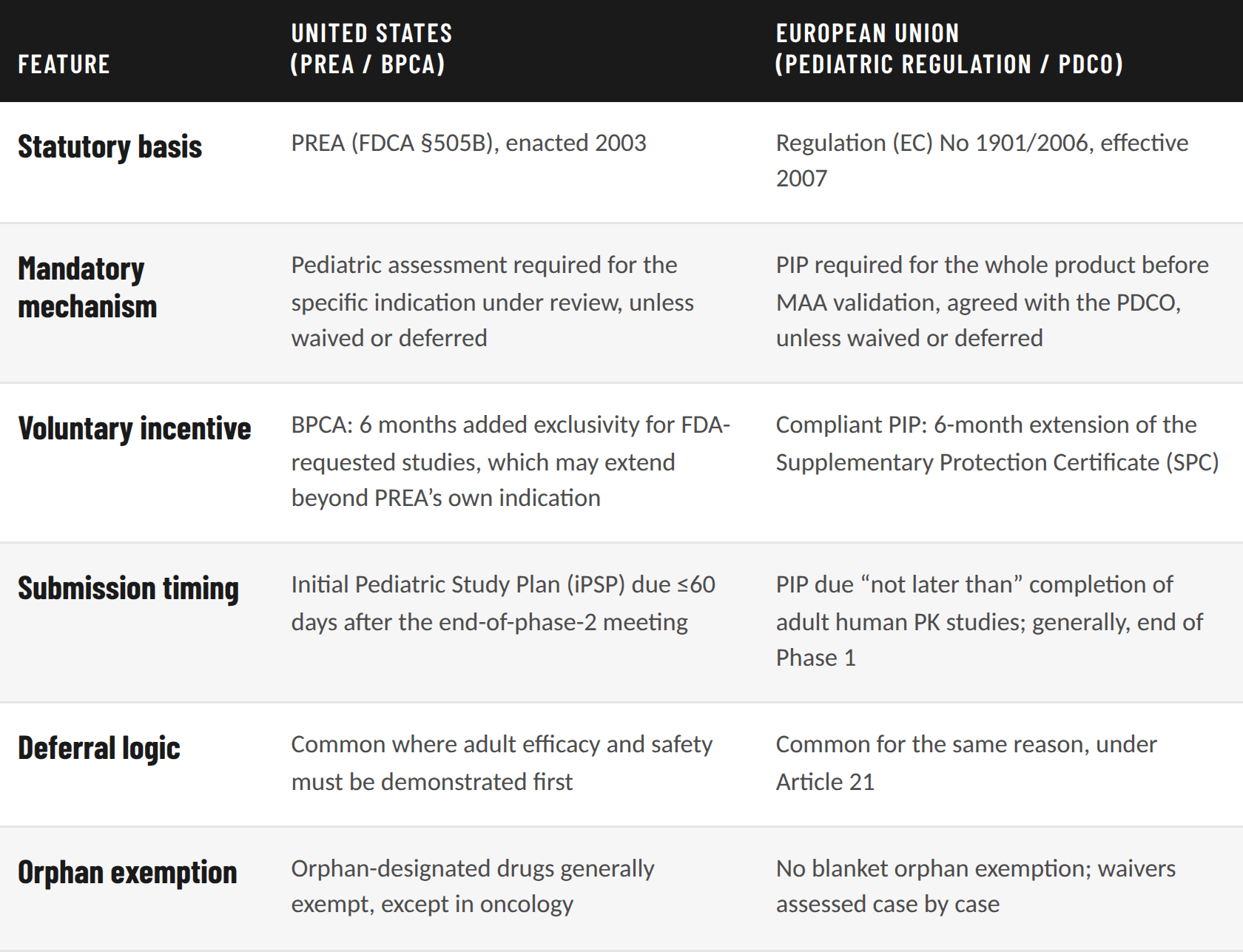
The practical upshot: both systems assume, by design, that a sponsor will engage with pediatric regulators early, well before the pediatric program itself begins, even in therapeutic areas where the actual pediatric studies will be deferred for years.
While PREA and the EU Pediatric Regulation dominate global pediatric planning discussions, they are not universal models.
Japan and China currently take a more incentive-driven approach. In Japan, pediatric drug development is generally treated as an "effort obligation" rather than a mandatory filing requirement, even following the May 2025 PMD Act reforms. Regulators have increasingly encouraged sponsors to discuss pediatric development plans during adult development, but participation is driven primarily through incentives such as extended re-examination periods and reimbursement advantages rather than statutory obligations.
China's framework has evolved rapidly over the past decade. Pediatric medicines were first explicitly referenced in Chinese drug law through the 2019 Drug Administration Law, and incentives historically focused on priority review pathways. More recent implementing regulations introduced market exclusivity incentives for qualifying pediatric medicines, moving the system closer to the incentive-based philosophy seen under the U.S. Best Pharmaceuticals for Children Act (BPCA).
The practical distinction is important: in the United States and European Union, pediatric planning is largely a matter of compliance. In Japan and China, it remains driven primarily by incentives. As a result, timeline pressures, development sequencing, and regulatory negotiations may look very different from those associated with PREA or a PIP obligation.
For AOMs specifically, deferral is close to the default position on both sides of the Atlantic, and for the same underlying reason. FDA’s January 2025 draft guidance states plainly that “generally, efficacy and safety data in adults should be available before a new drug is studied in children,” reflecting the view that a year-long, placebo-controlled pediatric exposure is difficult to justify scientifically or ethically before the adult benefit-risk profile is established. The EU’s Article 21 deferral serves the identical function.
This doesn’t mean pediatric planning waits. FDA’s guidance notes that pharmacokinetic characterization in pediatric subjects, in patients with age- and sex-matched BMI at or above the 95th percentile, may be appropriate before long-term pediatric trials begin, and both the iPSP and PIP dialogues are structured to start while the program is still adult-only. The deferral defers the trials, not the regulatory conversation.
That shared deferral logic is the backdrop for FDA’s 2025 draft guidance. The guidance does not remove the need for early pediatric planning; it makes the eventual pediatric protocol more concrete by specifying the age bands, endpoints, safety domains, and eligibility assumptions that sponsors should anticipate.
The FDA’s draft guidance, “Obesity and Overweight: Developing Drugs and Biological Products for Weight Reduction,” revises a 2007 guidance and, for the first time, sets out a dedicated section on pediatric assessment (Section IV) with several concrete, previously unwritten expectations:
Developmental stratification: pediatric trials should include subjects aged 6 and older, but separate trials or cohorts are generally recommended for adolescents (12 and older) and younger pediatric subjects (6–11): a single all-ages pediatric cohort is no longer the assumed design.
Eligibility: subjects should have age- and sex-matched BMI at or above the 95th percentile (or 85th percentile with a weight-related comorbidity in adolescents) and a documented history of failure to lose sufficient weight with lifestyle modification.
Representation: 30% or more of enrolled subjects should meet criteria for severe obesity.
Primary endpoint: mean percentage change in BMI rather than body weight, since growth itself must be accounted for in a population that has not reached terminal height. A wall-mounted stadiometer should be used at every visit.
Body composition: baseline and follow-up DXA (or a suitable alternative) is expected in pediatric subjects, as in adults.
Growth and pubertal safety: Tanner staging and bone age should be assessed at baseline and endpoint, in addition to standard safety monitoring.
Neuropsychiatric assessment: trials of centrally acting weight-reduction drugs in pediatric subjects should include fit-for-purpose assessments of depression, suicidality, and neuropsychiatric function, the same territory covered in more depth in our companion piece on suicidality monitoring in pediatric GLP-1 trials.
None of these individually is a radical departure from general pediatric drug development practice. Together, they represent the first time FDA has written obesity-specific pediatric trial design expectations into a single guidance document, which gives sponsors a considerably firmer target than the general PREA framework alone provided.
Trial design doesn’t happen in a clinical-practice vacuum, and the standard of care for pediatric obesity shifted meaningfully in 2023. The American Academy of Pediatrics’ Clinical Practice Guideline for the Evaluation and Treatment of Children and Adolescents With Obesity explicitly ended the prior “watchful waiting” model, stating there is no evidence that delayed treatment is appropriate. In its place, the guideline recommends intensive health behavior and lifestyle treatment as the foundation from age 6, with weight-loss pharmacotherapy offered as an adjunct for adolescents 12 and older with obesity, and referral for bariatric or metabolic surgery evaluation for adolescents 13 and older with severe obesity.
This creates a genuine design tension worth naming rather than glossing over. FDA’s eligibility criteria call for a documented history of failure to lose sufficient weight with lifestyle modification, language written for a world where lifestyle-only treatment is tried first, for some meaningful duration, before pharmacotherapy is considered. But the AAP guideline that sponsors’ own site investigators are now practicing under recommends offering pharmacotherapy adjunctively and earlier, not only after a prolonged lifestyle-only trial. As real-world practice moves earlier, protocols that lean on “documented failure of lifestyle modification” as an eligibility gate may need to define what constitutes an adequate trial of lifestyle treatment more explicitly, both for enrollment feasibility and for defending the eligibility criteria to an IRB or ethics committee against the current standard of care.
One further wrinkle matters for regulatory strategy. FDA has separately proposed, in draft guidance on complying with PREA and qualifying for BPCA exclusivity, that BPCA written requests may no longer be issued solely for studies a sponsor is already required to conduct under PREA. Historically, a sponsor could align mandatory PREA studies with a voluntary BPCA written request covering the same work, effectively earning the six-month exclusivity reward for studies it had to perform regardless. If finalized, this position would close that overlap; sponsors building pediatric AOM development plans should model their exclusivity strategy using the more conservative interpretation rather than relying on historical practice.
For sponsors and CROs building or refining a pediatric AOM program, four practical implications follow directly from the above:
Engage FDA and the PDCO in parallel and early: the iPSP and PIP conversations should start while the program is still adult-only, even though the pediatric trials themselves will likely be deferred.
Design the 6–11 and 12–17 cohorts as separate trials or analysis strata from the outset. Retrofitting stratified analyses onto a protocol written for a single pediatric age band is far costlier than building it in from the start.
Build DXA, Tanner staging, bone age, and fit-for-purpose neuropsychiatric assessment into the pediatric protocol and eCOA/COA plan from day one: these are no longer implicit best practice but explicit expectations in the current draft guidance.
Treat the AAP-guideline-driven shift in standard of care as a live design variable. Eligibility language built around “failure of lifestyle modification” should be defined with enough specificity to withstand scrutiny against a standard of care that itself is moving toward earlier pharmacotherapy.
Translate regulatory expectations into operational detail early, including endpoint strategy, site workflows, eCOA/COA implementation, rater and assessor training, and pediatric-specific safety monitoring, so that the protocol is not only regulatorily defensible but feasible to execute.
The regulatory architecture for pediatric AOM trials is more fully specified today than it was even eighteen months ago, but specificity is not the same as simplicity. Sponsors who treat PREA, the PIP process, the January 2025 FDA guidance, evolving pediatric obesity practice, and the broader global pediatric regulatory landscape as a single integrated framework will be better positioned to protect timelines, align evidence generation across regions, and defend the scientific credibility of their pediatric programs.

|
Dr. Figueroa is a Clinical Scientist with the eCOA Science Team at Signant Health, where she leverages her extensive expertise in electronic Clinical Outcome Assessments (eCOA) across diverse therapeutic areas, including oncology, dermatology, and infectious diseases. With over a decade of translational research experience, Dr. Figueroa is dedicated to advancing the field of clinical trials and improving patient outcomes through innovative methodologies and strategic insights. Her work at Signant Health focuses on integrating cutting-edge eCOA technologies to enhance the accuracy and reliability of clinical data, ultimately contributing to more effective and patient-centric healthcare solutions. |
 |
Dr. Graham C Ellis, MD, is Clinical Vice President at Signant Health. A specialist physician with more than 25 years of experience in diabetes, endocrinology, and metabolic disease, he has served as Principal Investigator on more than 150 international clinical trials. Dr. Ellis previously served as Executive Director of Medical Science and Strategy at PPD, the clinical research business of Thermo Fisher Scientific, and is a founding member of the Centre for Diabetes and Endocrinology (CDE). |
 |
Dr. Busner has over 35 years of experience as an academic psychiatric researcher, serving as Principal Investigator for 49 clinical trials and Sub-Investigator for 35 more. She has authored or co-authored over 140 peer-reviewed articles and presentations. Before joining Signant Health, she directed psychiatric clinical trials at two major medical schools and served on University IRBs for 20 years. Currently an Affiliate Associate Professor of Psychiatry at Virginia Commonwealth University, Dr. Busner leads studies at Signant on pediatric, rare, and psychiatric disorders, and has trained thousands of clinical trial investigators worldwide. |