Part of an Eight-Chapter Series
This article is one of eight exploring the clinical trial science behind pediatric and adolescent obesity medicine, written by Signant Health’s clinical scientists and regulatory specialists.

Most childhood obesity is polygenic and shaped by the food environment. A small minority of children, however, have a different disorder: Hypothalamic obesity (HO). The term hypothalamic obesity has been used to define those rare forms of severe obesity where a clear hypothalamic substrate can be identified, and includes monogenic, syndromic and acquired hypothalamic obesity.
Monogenic obesity is caused by a lesion in the leptin–melanocortin pathway, which links peripheral energy stores to hypothalamic appetite control (Figure 1). Leptin from adipose tissue binds LEPR on arcuate nucleus POMC neurons. PCSK1 processes POMC to α-MSH, which activates MC4R on paraventricular neurons, promoting satiety and energy expenditure.1,2
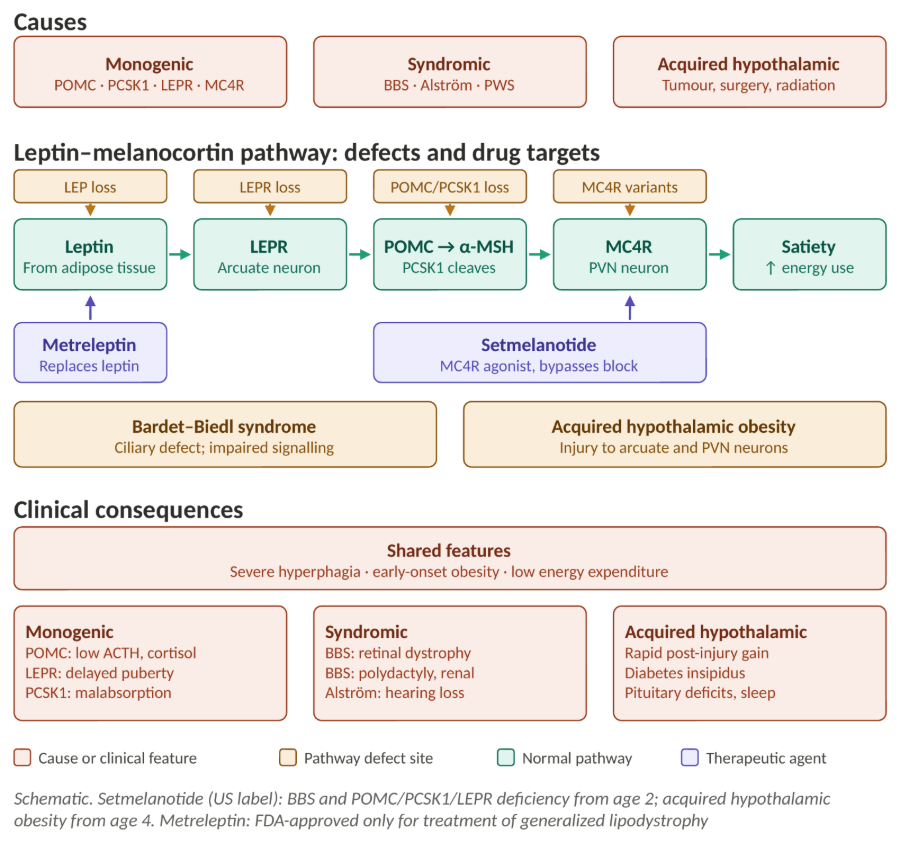
Figure 1. Leptin–melanocortin pathway: causes, defects, drug targets and clinical consequences of monogenic, syndromic and acquired hypothalamic obesity.
Abbreviations: ACTH, adrenocorticotropic hormone; α-MSH, alpha-melanocyte-stimulating hormone; BBS, Bardet–Biedl syndrome; FDA, Food and Drug Administration; LEP, leptin; LEPR, leptin receptor; MC4R, melanocortin-4 receptor; PCSK1, proprotein convertase subtilisin/kexin type 1; POMC, proopiomelanocortin; PVN, paraventricular nucleus; PWS, Prader–Willi syndrome; US, United States.
Disruption anywhere along this axis produces pathological hyperphagia, not simply increased appetite, typically from early childhood. Monogenic forms include biallelic loss of POMC, PCSK1 or LEPR, while heterozygous MC4R variants are the most frequent monogenic cause.2 Syndromic forms, such as Bardet–Biedl syndrome, a ciliopathy, impair neuronal signaling within the same pathway.3 Prader–Willi syndrome, included in Figure 1 for completeness, produces hyperphagia through a distinct hypothalamic mechanism and is not an approved indication for MC4R agonism.5 Acquired hypothalamic obesity follows injury to arcuate and paraventricular neurons, commonly from craniopharyngioma or its treatment.1,4
The clinical picture extends beyond weight. Gene-specific endocrine features occur, and syndromic and acquired forms involve multiple organ systems. Pediatric evidence is limited, drawn largely from small, uncontrolled studies and registries.1 For trial design this means very small populations, genotype-gated eligibility and hyperphagia-focused endpoints.
Setmelanotide, an MC4R agonist, is the only agent with pivotal data in this population.1–4 Treatment response is largely genotype-dependent, with non-responsiveness occurring in individuals whose mutations lie outside or downstream of MC4R signaling pathways which underscores the necessity for precise molecular diagnostics. Well controlled data remain limited and the youngest age groups rest on the thinnest evidence.
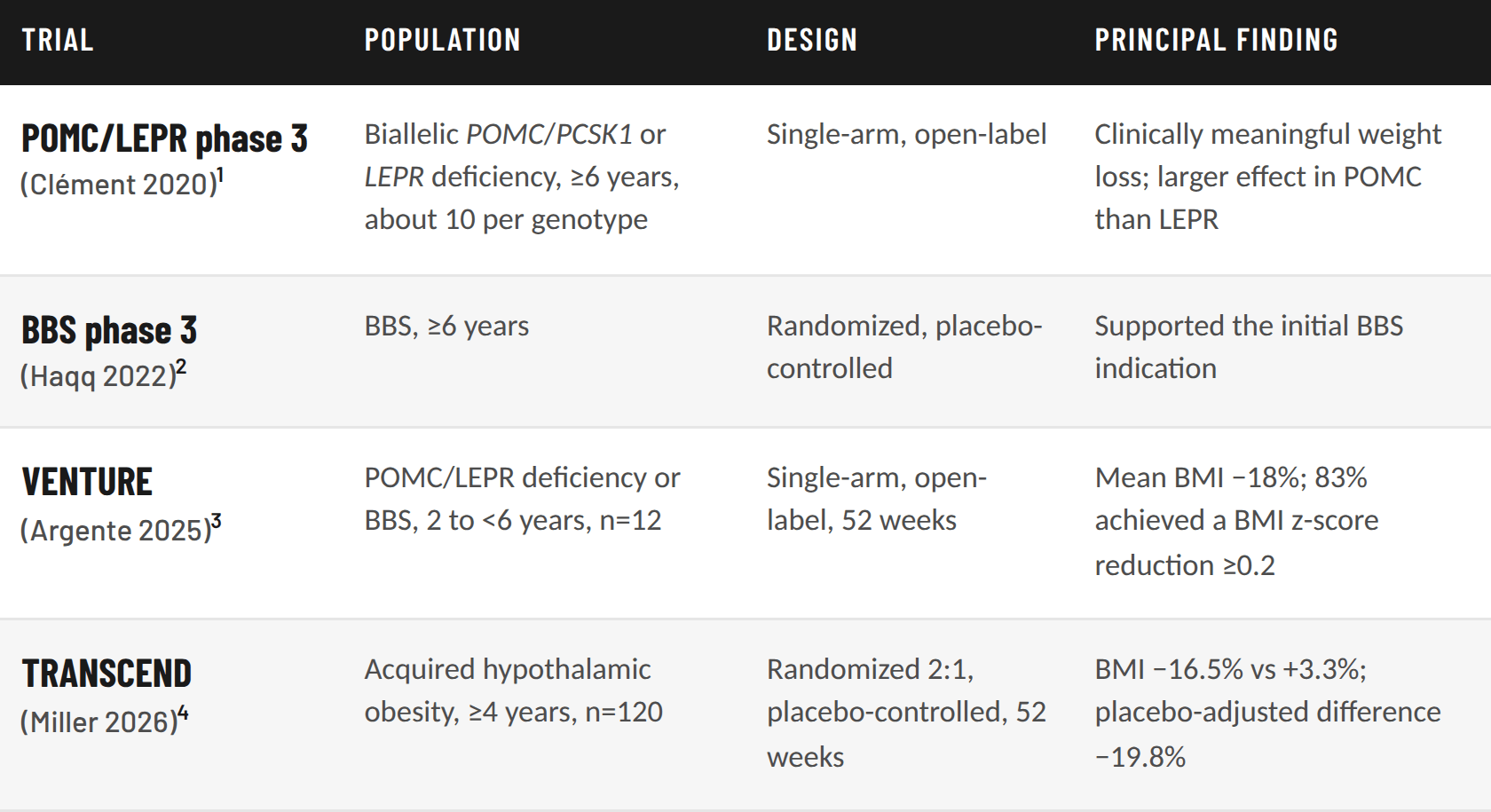
TRANSCEND is the largest placebo-controlled trial in acquired hypothalamic obesity.4 Hunger scores improved in participants aged 12 years and over, the group able to self-report on the 11-point scale used. Hyperpigmentation, nausea and vomiting were common, and melanocytic naevi were more frequent with active treatment.
Four important limitations apply to the available data: First, VENTURE, which supports the approval from age 2, was small and uncontrolled, so the treatment effect rests partly on extrapolation from older children.3,5 Second, the effect varies by genotype: BMI fell by about 26% in POMC/LEPR deficiency but by about 10% in BBS. Third, hunger could be measured by self-report only from age 12, so younger children depend on caregiver-reported measures. Fourth, long-term data on growth, pubertal development and skin lesion surveillance remain limited.
GLP-1 receptor agonists and other incretin-based drugs are used off-label in acquired hypothalamic obesity, since setmelanotide is the only agent with a labelled indication. The rationale is mechanistic: GLP-1 acts as a neuropeptide through central satiety pathways that are independent of the hypothalamus, so it may work even when hypothalamic circuits are damaged. The evidence for efficacy, however, is weak. recent review identified 7 case reports, 5 case series and 2 published trials. Case reports uniformly described weight loss, probably reflecting selective reporting of favorable outcomes, whereas case series were variable. In the principal randomized trial (ECHO; 42 participants aged 10–25 years, once-weekly exenatide versus placebo for 36 weeks), BMI change did not differ significantly from placebo, although measures of adiposity such as fat mass and waist circumference improved.6,7 Semaglutide looks more promising in small craniopharyngioma series (four women treated for 6 months, followed up to 24 months),8 and Pediatric experience is limited to single-center series and conference reports.9–112
The question for trial design is not whether GLP-1 agents work, but how sponsors handle patients who are already taking them. Concomitant use is likely to be common and heterogeneous, which makes it a stratification and eligibility issue. The first Pediatric randomized evidence may come from SEMAFORCRANIO, a placebo-controlled phase 3 trial of semaglutide in adolescents aged 12–17 with craniopharyngioma-related hypothalamic obesity, authorized in the EU with recruitment pending.12
Together, these points set up the design challenges outlined below.
The biology described in Section 1 and the evidence in Section 2 change how a trial is designed. Five features distinguish these studies from conventional Pediatric obesity trials.
Endpoints. BMI percent change and BMI z-score remain the anchor measures of weight, and VENTURE reported the proportion of children achieving a BMI z-score reduction of at least 0.2.1 Hunger, however, becomes a primary or key secondary endpoint, because hyperphagia is a defining symptom. In children under six, BMI z-score is also an imperfect measure at the upper extreme of the distribution, an issue shared with severe obesity more broadly.
Sample size. Enrolment ranged from 12 children in VENTURE to 120 in TRANSCEND, spread across international sites.1,2 At this scale each missing observation matters. Within-patient comparisons, extension periods, registry follow-up and natural-history comparators become part of the design discussion, supported by regulatory guidance on rare diseases and Pediatric extrapolation.3,4
Genotype-gated eligibility. Participants must have genetically confirmed disease, so central genetic testing, variant adjudication and a clear definition of "pathogenic" must be in place before the first patient is screened. Syndromic and acquired forms need their own diagnostic criteria, such as clinical criteria for Bardet–Biedl syndrome5 and documented hypothalamic injury.
Age stratification. The trials span ages 2 to adulthood. Young children cannot self-report, so caregivers become the main source of outcome data, with age-specific instruments for each developmental stage.
Duration and follow-up. The pivotal trials ran for 52 weeks, but the conditions are lifelong. Long-term growth, pubertal progression and safety monitoring therefore depend on extension studies and registries.
These requirements make measurement, not randomization, the central design challenge.
If weight is the easier endpoint to measure in these trials, hunger is the harder and more important one. Hyperphagia in MC4R-pathway disease is a pathological drive to eat, qualitatively different from ordinary appetite, and few instruments were built to capture it.
A measurement gap by age. In TRANSCEND, participants aged 12 years and overrated their own hunger on an 11-point scale.3 Below that age, self-report is not feasible, and data must come from caregivers. The same construct therefore has to be measured in two ways, and the two must be reconcilable across a trial that spans ages 2 to adulthood.
Content validity. FDA's PRO guidance and patient-focused drug development series expect evidence that an instrument captures what matters to the population in which it is used.1,2 For hyperphagia in very young or cognitively impaired children, that evidence is limited, so instrument development and validation often run alongside the clinical program.
Observer-reported outcomes. Caregiver ratings need clear attribution, well-defined recall periods and training, so that what a parent observes is separated from what they infer. Caregiver burden and family functioning are also relevant secondary measures, since hyperphagia affects the whole household.
Accessibility. Syndromic and acquired forms add visual impairment, cognitive difficulty, fatigue and behavioral challenges. Electronic instruments need accessible design, and site workflows need to allow for assisted completion without compromising data integrity.
Ethical considerations. Assent must be adapted to developmental level. Genetic testing raises questions for the wider family. Trial materials should avoid language that implies blame.
Taken together, this is where electronic COA design directly affects whether a trial can demonstrate benefit.
Signant Health's Pediatric eCOA program has supported more than 190 Pediatric studies and over 80,000 young patients, and its obesity work includes more than 30 trials of GLP-1 receptor agonists.1 Four capabilities map directly onto the requirements highlighted earlier.
Caregiver and observer workflows. Purpose-built observer-reported outcome (ObsRO) pathways give caregivers their own credentials, instructions and recall periods, separate from the child's.
Developmental- age-appropriate design. Instruments and interfaces can be adapted to developmental stage, reading level and accessibility needs.
Separate assent and consent. The SmartSignals eConsent platform supports distinct assent and consent workflows, with developmental- age-appropriate design.
One integrated platform. eCOA, eConsent, EDC, TeleVisit and randomization and trial supply management (RTSM) sit in a single system, which limits the fragmentation that creates data-integrity risk in small, long-running studies.
HO trials draw on a wider range of endpoints than any other part of the obesity spectrum, and no single instrument covers them. Weight and BMI z-score are measured at the site. Hunger is reported by the child or, in younger patients, by a caregiver. The condition also affects sleep, activity, mood and eating behavior. An integrated platform can bring these streams together: caregiver and self-reported hunger instruments, eConsent, and site data sit in one system, so each participant has a single record across the study.
Wearables add an objective layer. Research-grade actigraphy, available through Signant's ActiGraph integration with the DECODE Obesity consortium, can capture physical activity and sleep in sub-studies, and can sit alongside self-reported hunger and quality-of-life measures as supportive evidence.1 Consumer wearables and connected home scales, which the platform is being extended to support, could add activity and weight between visits and reduce visit burden. Where mood or eating behavior is monitored, scheduled and interim assessments with automated site alerts and a full audit trail support safety oversight.
For sponsors, the practical point is early involvement. Choices about who reports, at what age, how often, and which objective measures are collected are best made at protocol design rather than after first patient in. Approvals now reach age 2 for genetic obesity and age 4 for acquired hypothalamic obesity,2 and the next generation of agents is already in development. Measuring hunger well will matter as much as measuring weight.

|
Dr. Graham C Ellis, MD is a Clinical Vice President at Signant Health. A specialist physician with more than 25 years of experience in diabetes, endocrinology, and metabolic disease, he has served as Principal Investigator on more than 150 international clinical trials. Dr. Ellis previously served as Executive Director of Medical Science and Strategy at PPD, the clinical research business of Thermo Fisher Scientific, and is a founding member of the Centre for Diabetes and Endocrinology (CDE). |
 |
Elias Ketiar, MD, MRCP serves as the Clinical Vice President, Science & Medicine, at Signant Health. Dr. Ketiar draws on his wealth of more than 20 years of academic and clinical experience to advise on clinical trial design, execution, and governance. He has extensive experience in General Internal Medicine and Cardiology and is a Member of Royal College of Physicians (London), UK. Dr Ketiar has been engaged in academic research and was involved in a pioneering project investigating genetic causes of congenital heart disease, which culminated in a Medical Doctorate with St George’s University of London, UK. He also has peer reviewed papers published. He has always been involved in all phases of clinical development and interested in global clinical trial solutions. |


