Part of an Eight-Chapter Series
This article is one of eight exploring the clinical trial science behind pediatric and adolescent obesity medicine, written by Signant Health’s clinical scientists and regulatory specialists.

The landmark anti-obesity medication (AOM) trials reviewed in our first blog in this series all converged on a single primary endpoint: percentage change in BMI from baseline. Although this approach remains accepted by regulators, its applicability to the population has garnered substantial scientific and methodological criticism. How trial sponsors resolve this is now a defining consideration in AOM development.
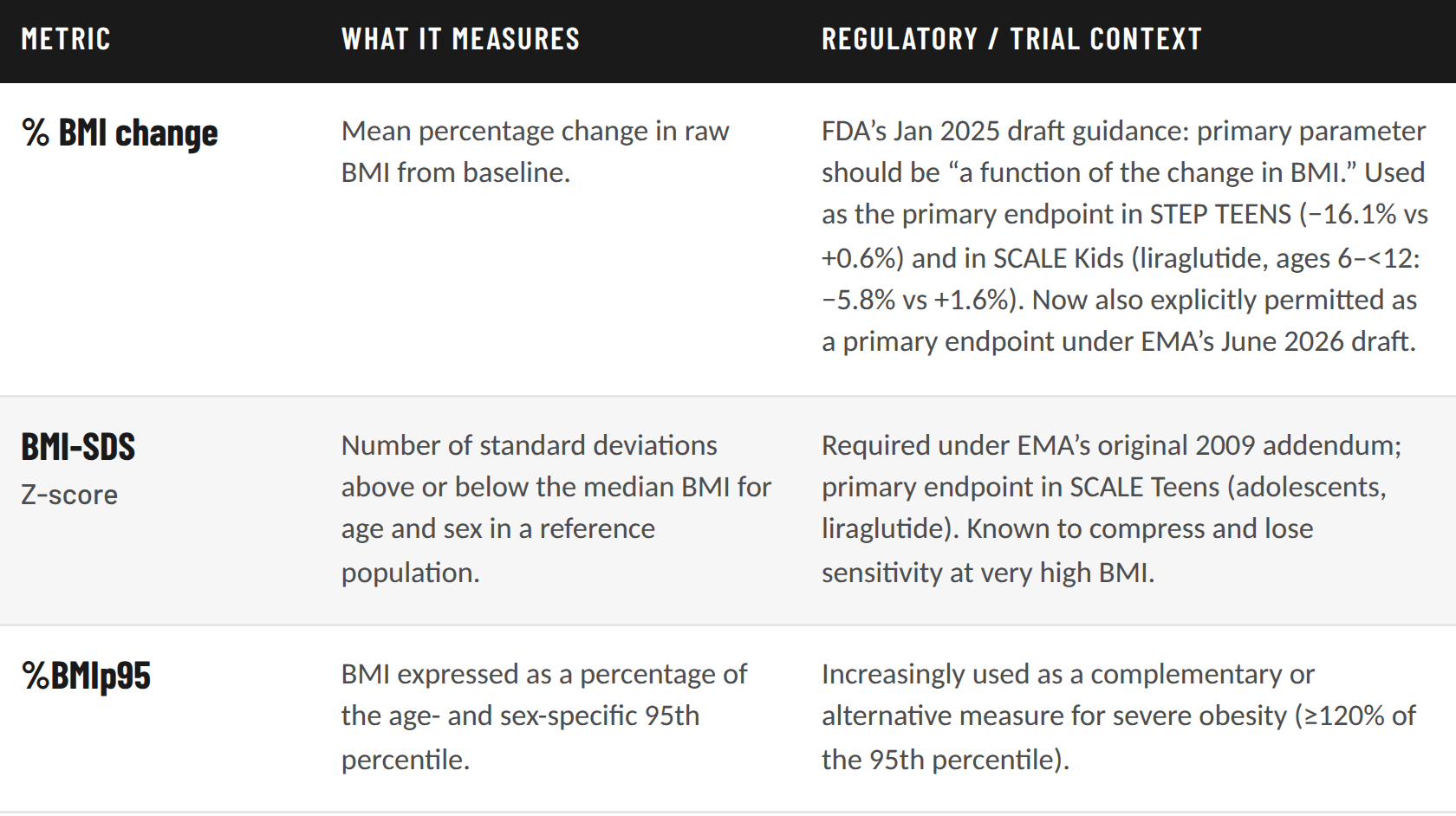
The FDA’s January 2025 guidance, Obesity and Overweight: Developing Drugs and Biological Products for Weight Reduction, states that “because linear growth should be considered when assessing changes in the body weight of children and adolescents, the primary efficacy parameter in weight-reduction trials of subjects should be a function of the change in BMI (e.g., the mean percentage change in BMI).”¹ Such an outcome was used for the primary endpoint in the STEP TEENS trial (NCT04102189) of semaglutide in adolescents (‒16.1% vs. +0.6% with placebo at week 68).²
The EMA’s original 2009 addendum on weight control in children, by contrast, has recommended BMI standard deviation score (BMI-SDS) as the primary endpoint, the metric underpinning the original Saxenda approval in adolescents (SCALE Teens (NCT02918279)), on the grounds that a growing child's BMI-SDS is comparatively stable over time even as absolute weight and height increases.3,4 However, in the companion SCALE Kids liraglutide trial in children 6 to under 12, the primary endpoint was mean percentage change in BMI, not BMI-SDS, in which the trial’s authors tied to the distinct physiology of pre-pubertal versus pubertal growth.6 A new draft revision of the addendum, opened for public consultation on 24 June 2026 (through 31 October 2026), anticipates a change in the EMA policy, permitting mean percentage change in BMI, percentage of the 95th BMI percentile (%BMIp95), or percentage of median BMI as primary endpoints alongside BMI-SDS, and formally requires trials to be stratified or separately conducted for pre-pubertal versus pubertal participants.7
The third metric, %BMIp95, remains a useful complementary measure, particularly for children with severe obesity, where BMI-SDS is known to compress at the upper extreme and lose sensitivity to change.8 No single metric is problem-free across the full severity spectrum, which the 2022 “Metrics Matter” consensus paper by Ryder, Kelly, and Freedman addresses. In the paper, it is highlighted that inconsistent BMI-derived metrics across trials undermines cross-trial and meta-analytic comparability, which is why both FDA and the new EMA draft now call for multiple BMI-related metrics to be reported as secondary endpoints even when only one is primary.⁹
Both FDA and EMA guidance now converge on requiring objective body-composition assessment. FDA’s 2025 draft guidance states that “baseline and follow-up measurement of body composition by DXA or suitable alternative should be obtained in subjects” to confirm that “drug-induced or biologic-induced weight reduction is caused primarily by a reduction in fat content, not lean-body mass.”1 The EMA’s draft further outlines requiring imaging-based body composition (DXA or MRI) as a secondary endpoint specifically to rule out disproportionate lean-mass loss, and recommends muscular-functionality testing where feasible.7 Whole-body dual-energy X-ray absorptiometry (WB-DXA) is the preferred method in both frameworks, but as both agencies acknowledge, it requires multiple blinded, central readers to implement consistently across sites, presenting a genuine operational burden for the multinational, lower-resource-region site networks increasingly central to obesity recruitment.
As obesity drug development has accelerated, sponsors face growing pressure to demonstrate treatment effects that meaningfully benefit the participant in how they feel and function, extending beyond weight loss. This has prompted interest in wearable-derived measures of physical activity, functional mobility, and sleep that avoid the recall bias of clinic-visit questionnaires. Although no wearable-derived activity, mobility, or sleep endpoint has yet been formally qualified by the FDA or EMA for use in obesity trials, the evidence base is being generated substantially by industry consortia working toward that eventual goal.
The most visible such effort is DECODE-Obesity, a pre-competitive working group coordinated by Ametris (formerly ActiGraph), a Signant Health company. Founding members are Eli Lilly, F. Hoffmann-La Roche, and Novo Nordisk, joined by AstraZeneca and AbbVie in December 2025.10,11,12 This pioneering initiative is building the evidence base and driving regulatory engagement with FDA and EMA to establish wearable-derived physical activity, functional mobility, and sleep measures as validated, trial-ready endpoints.
Activity intensity and volume, sleep architecture, and gait patterns shift with developmental stage, and algorithms validated in adults do not reliably transfer to younger cohorts. Work classifying activity intensity from wrist-worn accelerometers in 8- to 12-year-olds has had to build age-specific models rather than borrow adult thresholds outright, reflecting a wider body of accelerometer-based research into how children's activity should be measured and interpreted.13
This distinction is clinically important. A 2021–2022 pilot home-monitoring study compared 28 children with obesity (mean BMI 30.9) to 128 healthy-weight controls over 28 days of smartwatch- and blood-pressure-cuff-based monitoring, and found that children with obesity were consistently less active and had elevated heart rate, blood pressure, and shorter sleep duration than their healthy-weight peers, with the digital measures able to distinguish the two groups.14
Emerging evidence further supports moving beyond moderate-to-vigorous physical activity (MVPA) minutes alone. A 2026 cross-sectional study of 91 children and adolescents with obesity (ages 6–17) used thigh-mounted accelerometry and an unsupervised machine-learning method (DDRTree) to identify three physical-activity phenotypes: Sedentary (24%), Light Activity (55%), and Higher Activity (21%). Notably, only three of the 91 participants met WHO MVPA recommendations at all. Relative to the sedentary phenotype, the higher activity phenotype accumulated 122 fewer sedentary minutes and 16.5 more MVPA minutes per day (p<0.001), and showed lower fat-mass percentage, higher fat-free-mass percentage, greater insulin sensitivity, and a lower composite metabolic-risk score (all p≤0.05).15
These findings indicate that multidimensional accelerometry features, including sedentary accumulation, light-intensity activity, activity fragmentation, bout structure, and transition frequency, capture clinically meaningful variation in cardiometabolic risk that MVPA duration alone misses. Realizing the potential of capturing objective physical activity measurement at scale depends on platforms with an established evidence base, covering wear-time validation, epoch selection, physical activity fragmentation, and sleep-staging algorithms tuned to growing bodies.
Based on these developments, recruitment for obesity trials has become more complex. Growth reference inconsistency is a documented confound, where eligibility thresholds can shift depending on which chart a site defaults to. A 2024 reanalysis of an adolescent weight management trial outlines this, finding that BMI z-score treatment effects varying nearly fourfold depending on whether CDC, WHO, or IOTF charts were used.16
Due to the increasing expectation that excess adiposity must be confirmed with an anthropometric measure or direct body composition analysis via WB-DXA or BIA, screening will demand imaging capacity, trained staff, and radiation-consent processes, which can reduce the pool of sites that can realistically enrol patients, impacting operational and per-patient costs.
In addition, considering the divergent regulatory expectations, where FDA and EMA don't yet agree on a single preferred BMI metric, sponsors may calculate multiple growth-reference outputs from one dataset just to satisfy both agencies, adding statistical complexity.
In terms of endpoint selection, these developments point to a obesity trial in which the primary endpoint is no longer a single clinic-measured number. A modern protocol may need to reconcile:
Anthropometric endpoints (BMI-SDS and/or %BMI95, alongside %BMI) recorded at scheduled visits;
Centrally read DXA body-composition data at baseline and follow-up;
Continuous wearable actigraphy capturing physical activity, mobility, and sleep;
Age-banded PRO and ObsRO instruments, with caregiver proxy-report for younger children transitioning toward self-report in adolescence; and
Tanner staging and bone age, already required by FDA guidance for centrally acting agents, as a further growth-adjustment covariate.
For eCOA platforms, systems must not only deliver age-appropriate, validated PRO/ObsRO instruments to the correct respondent, but also ingest and time-align wearable data streams alongside them, maintain the audit trail needed to satisfy DHT verification and analytical-validation expectations, and support the transition of reporting responsibility from caregiver to child as a participant matures over a trial.
Three things are reasonably well-established for obesity trials in 2026: 1) BMI-derived metrics remain the required primary efficacy measure for both FDA and EMA, 2) body-composition assessment by WB-DXA or an equivalent is now expected as standard secondary evidence rather than an optional add-on, 3) and pre-pubertal versus pubertal status is emerging as the key stratification variable, echoing the physiological reality that a 7-year-old and a mid-pubertal 15-year-old are not comparable growth trajectories. Furthermore, objective, wearable-derived measures of activity and function constitute a rapidly maturing area of methods development with a well-defined scientific rationale; generating sufficient data to support formal agency qualification is the critical next step.

|
Lauren Crooks, MSc has comprehensive cross-functional experience within the life sciences and information technology sectors. At Signant, she combines this experience to provide scientific consultation and support to clients on the implementation of eCOA to optimize patient care and outcomes in clinical trials. She has supported eCOA projects across multiple therapeutic areas, including dermatology and neurology, with a current focus on respiratory diseases. |
 |
Dr. Sylvain Zorman, PhD is Director of DHT Solutions Strategy at Ametris (formerly ActiGraph). A biophysicist by training with more than a decade of experience in digital health technologies and connected medical devices, he has led the implementation of digital endpoint solutions for clinical evidence generation in global Phase 2 and Phase 3 studies. Dr. Zorman previously served as Digital Solution Manager at Novartis. |
 |
Dr. Graham C Ellis, MD, is Clinical Vice President at Signant Health. A specialist physician with more than 25 years of experience in diabetes, endocrinology, and metabolic disease, he has served as Principal Investigator on more than 150 international clinical trials. Dr. Ellis previously served as Executive Director of Medical Science and Strategy at PPD, the clinical research business of Thermo Fisher Scientific, and is a founding member of the Centre for Diabetes and Endocrinology (CDE). |