Part of an Eight-Chapter Series
This article is one of eight exploring the clinical trial science behind pediatric and adolescent obesity medicine, written by Signant Health’s clinical scientists and regulatory specialists.

In pediatric obesity trials, the weight endpoint carries decades of regulatory precedent. The patient-reported outcome (PRO) carries a patchwork of questionnaires, age limits and open questions about what a score means. The challenge is that no single instrument fits every age, reporter and regulatory purpose; this post shows how to choose one, covering available instruments, what pivotal programs did, what regulators expect and where selection goes wrong.
ICH E11 defines children as 2 to 11 years and adolescents as 12 to 16-18, depending on the region.1 In obesity drug development, FDA’s draft guidance (January 2025, non-binding) recommends trials from age 6, with separate cohorts for 6 to 11 and 12 and older.2 EMA’s June 2026 draft guideline splits pre-pubertal from pubertal children (Tanner stage 2 onwards) instead.3 Wegovy (semaglutide) and Saxenda (liraglutide) are approved from age 124,5; STEP Young and SCALE Kids evaluated ages 6 to under 12 years.6,7 Since instruments are validated for age bands, not regulatory cohorts, age determines the initial candidate set. Three further filters narrow it: who reports (child or parent), whether the response scale suits the child’s development, and whether the evidence supports the instrument for that age group and purpose.
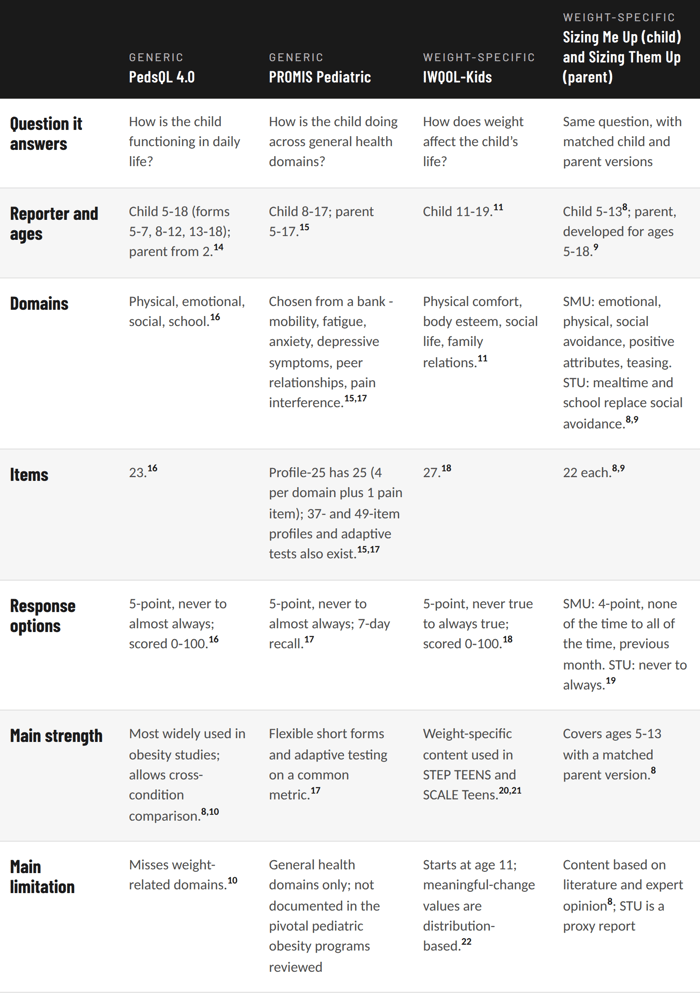
Generic measures ask how a child functions in daily life, allowing comparison across diseases; weight-specific measures ask how weight affects daily life, including teasing and body esteem that generic tools may miss.8,9,10 Combining both remains sound advice.11
No single instrument spans a pediatric obesity trial: only Sizing Me Up covers ages 6 to 10, IWQOL-Kids starts at 11, and no validated obesity-specific self-report was found under 5. ISPOR rates self-report unsupported under 5, questionable at 5-7, improving at 8-11 and preferred from 12.12 FDA discourages parent proxy reports in favor of observer reports of observable behavior.13
Table 1. Generic versus weight-specific instruments at a glance
PROMIS physical function items use “with no trouble” to “not able to do” instead.17
STEP TEENS (semaglutide, 12 to under 18) used percent BMI change as primary, with IWQOL-Kids an exploratory endpoint.21,23 FDA’s review called results numerically favorable but of unclear relevance, noting meaningful change had not been established.21 SCALE Teens (liraglutide) used BMI SDS as primary, with IWQOL-Kids as an unadjusted secondary.20 Neither adolescent label reports quality-of-life data.4,5
A statistically significant PRO change does not necessarily matter to a child or family. The minimal important difference (MID), the smallest change patients perceive as meaningful22, makes a score interpretable; FDA calls it the meaningful score difference.24 Pediatric thresholds are hard to carry across cohorts: values vary with baseline score24, instrument versions are not interchangeable13, and child and parent ratings diverge.16,25 Anchor-based methods are preferred over distribution-based estimates24, which underpin the published IWQOL-Kids values.22 Prespecifying the anchor and threshold, agreed early with FDA, avoids explaining the PRO after the fact.2,24
Registrations for SCALE Kids and STEP Young list no PRO among outcomes6,7, though planned PROs can sit in protocols.23 STEP Young reports at ObesityWeek, 14-17 November 202626; PHQ-9 and C-SSRS exclusions apply only to ages 12-17.27
FDA’s draft obesity guidance allows clinical outcome assessments (COAs) as secondary endpoints supporting labeling if each is fit-for-purpose, discussed early and controlled for multiplicity. PRO findings may support, but do not typically replace, weight reduction as the basis for labeling claims.2
FDA’s Patient-Focused Drug Development (PFDD) Guidance 3 (October 2025) prefers one instrument version across a trial’s age range where feasible, child self-completion without help and simplified scales for young children; a new or modified instrument should not debut in a registration trial.13 Guidance 4 (draft) asks for anchor-based evidence of the MID.24
EMA’s adult guideline asks for validated quality-of-life scores28, and the 2026 pediatric draft adds age-appropriate PROs, with quality of life as a secondary endpoint.3
No publicly reported pediatric obesity application has failed due to PRO selection; both adolescent labels reviewed omit quality-of-life data4,5, so the likelier consequence is no PRO-based claim.
Drawing on the regulatory documents, trial reviews and measurement studies cited in this post, six challenges recur across pediatric obesity programs, from how children respond to how scores are interpreted.
Cognitive gap. Recall windows and scales suited to an adolescent can fail a child.13
Parent-child disagreement. Disagreement is common and the direction varies: parents of 376 youths with obesity rated quality of life lower than the youths did, whereas in a community sample parents rated it higher.25,16
Content validity. In a review of obesity PROs, only one instrument involved children with obesity in qualitative item development.10
Weight versus well-being. In STEP TEENS, placebo-arm body esteem rose 5.6 points even though BMI did not fall, and baseline scores were already high on the 0-100 scale (about 84 overall, 96 for family relations), limiting room for improvement.21 With lifestyle support in both arms, weight change and well-being do not necessarily move together.
Limited generalizability. STEP TEENS excluded adolescents with significant depression or suicidality, which may limit generalizability to those with these conditions; 13 of 21 screen failures were attributed to these criteria.21
Meaningful change. Published MID estimates for IWQOL-Kids are distribution-based, deriving from score variability rather than patient-perceived benefit, and the four domain scores plus the total can create five endpoints, raising multiplicity risk.22,24
The steps below synthesize FDA and EMA guidance and the evidence cited in this post and are recommendations, not a regulatory checklist. Steps 1 to 6 cover selecting the PRO and steps 7 to 9 cover using it in the trial.
Determine the cohort frame (age vs puberty) before choosing tools.
Decide the PRO’s purpose: label claim, context, safety or payer evidence. A claim needs early FDA dialogue, a prespecified score and a prespecified place in the statistical testing order (the hierarchy), which controls false-positive risk; both adolescent labels omit quality-of-life data, so supportive use is the realistic default.
Define the concept of interest first (what matters to children), adding cognitive interviews where child input is missing.
Match reporter and form to age: child self-report from about age 8 (read-aloud support below), observer reports of observable behavior where self-report is impossible, and a plan for children who cross an age form mid-trial.
Pair a weight-specific instrument with a generic one.
Gather anchor-based MID evidence before the pivotal trial, as distribution-based values alone fall short.
7. Prespecify the analysis: collect PROs after treatment discontinuation, use a pre-randomization baseline and treat percent change for scores with caution.
8. Design the electronic clinical outcome assessment (eCOA) for children with audio, touch, neutral site staff and confirmed skips; paper-to-tablet migration rarely needs a new equivalence study, but altered recall periods or items may create a new measure, so check licensing.
9. Monitor mental-health safety separately from efficacy PROs, with a plan for children under 12.
Choosing a PRO for a pediatric obesity trial starts with age: no single instrument spans the 6-to-17 range; reporter, response scale and evidence must narrow the choice. Generic and weight-specific instruments work best together. In the adolescent programs reviewed, IWQOL-Kids was exploratory or secondary and neither label reports quality-of-life data, yet expectations are rising: FDA wants fit-for-purpose instruments with anchor-based evidence of meaningful change, and EMA’s 2026 draft calls for quality-of-life secondary endpoints. Parent-child disagreement, limited child input and uncertain MIDs remain the main obstacles.
STEP Young, which includes a group aged 6 to under 12, reports at ObesityWeek on 14-17 November 2026. Its registration lists no PRO, so the points to watch are whether one was collected, which instrument and age form were used, who completed it and where it sat in the testing hierarchy. Sponsors who plan the PRO as carefully as the weight endpoint will be best placed as instruments and evidence mature.

|
Jeanine Du Plessis, MSc is an Associate Director at Signant Health. Jeanine brings scientific and operational experience to advising and supporting clients on the delivery of eCOA, patient engagement, and trial strategy across non-CNS clinical trials. Jeanine is dedicated to helping sponsors design trials that put patients first, with a focus on better outcomes and a smoother experience for every participant. |
 |
Dr. Busner has over 35 years of experience as an academic psychiatric researcher, serving as Principal Investigator for 49 clinical trials and Sub-Investigator for 35 more. She has authored or co-authored over 140 peer-reviewed articles and presentations. Before joining Signant Health, she directed psychiatric clinical trials at two major medical schools and served on University IRBs for 20 years. Currently an Affiliate Associate Professor of Psychiatry at Virginia Commonwealth University, Dr. Busner leads studies at Signant on pediatric, rare, and psychiatric disorders, and has trained thousands of clinical trial investigators worldwide. |