Part of an Eight-Chapter Series
This article is one of eight exploring the clinical trial science behind pediatric and adolescent obesity medicine, written by Signant Health’s clinical scientists and regulatory specialists.

Picture a 14-year-old enrolled in an adolescent obesity trial after her mother, worried by years of pediatrician-led conversations about her daughter's weight, brought the study to the family's attention. The adolescent signed the assent form at the site visit and has raised no objection since. Whether that assent reflects a genuine, ongoing choice, or simply an absence of visible resistance, is the question this article addresses.
The expansion of adolescent anti-obesity medicine development has created a challenge that is less visible than endpoint selection or recruitment feasibility, but no less consequential: how to ethically engage adolescents who are increasingly active participants in their own healthcare decisions while remaining legally and practically dependent on parents or caregivers.
This is a study-design question, not merely a matter of signed forms. It determines whether an adolescent understands what participation requires, can make a voluntary choice, has a private route to report sensitive experiences, and remains willing to participate as circumstances and views evolve.
The stakes are particularly high in adolescent obesity trials. Weight-related stigma across healthcare, school, peer, family, and digital environments is associated with psychological distress, low self-esteem, maladaptive eating behaviors, and poorer health outcomes in young people.6,7,8,9 A study can meet minimum requirements for parental permission and assent while still leaving the adolescent’s voice constrained, private reporting compromised, or withdrawal as the only realistic way to express discomfort.
As trials become longer, more globally distributed, and more digitally enabled, ethical infrastructure — dynamic assent, privacy-by-design, role-specific data pathways, and informed family engagement — becomes inseparable from scientific validity. The question for sponsors is not whether a trial includes assent and privacy provisions, but whether those provisions are designed to work in the real lives of the young people producing the data.
Clinical trials involving minors carry enhanced safeguards because children and adolescents generally cannot provide legally valid consent independently. In the United States, research requires adequate provisions for parental permission and, when children are capable, solicitation of assent; the IRB determines whether assent is appropriate given age, maturity, and psychological state.
A common convention is to seek assent from around age seven, but this is not a federal legal threshold. 45 CFR 46, Sec. 46.408 requires the IRB to judge assent capability case by case — treating age alone as determinative risks overlooking real developmental differences within an adolescent trial population.2
The EU framework for clinical trials involving minors is similarly protective but operationally diverse: parental consent is required before enrolment, and the minor must receive age-appropriate information, be involved in decision-making, and have an explicit wish to refuse or withdraw respected.4 Notably, this creates an asymmetry rather than a mirrored right: a minor’s refusal or distress can override parental permission even where the minor cannot affirmatively authorize participation — so eCOA and app interfaces should give adolescents an unambiguous, always-available way to say no or stop, independent of what a caregiver has authorized.
International guidance reinforces this: ICH E11 states that Pediatric participants should receive information to the fullest extent possible in language they can understand and should assent to participation when appropriate under local regulation and ethics-committee expectations.5
The US/EU picture above is only part of the story for a multinational trial. Major regulatory regions differ not just in the numeric age at which assent is sought, but in the legal mechanism itself — whether assent is a documented absence of dissent, a binding refusal right, or a codified statutory threshold.
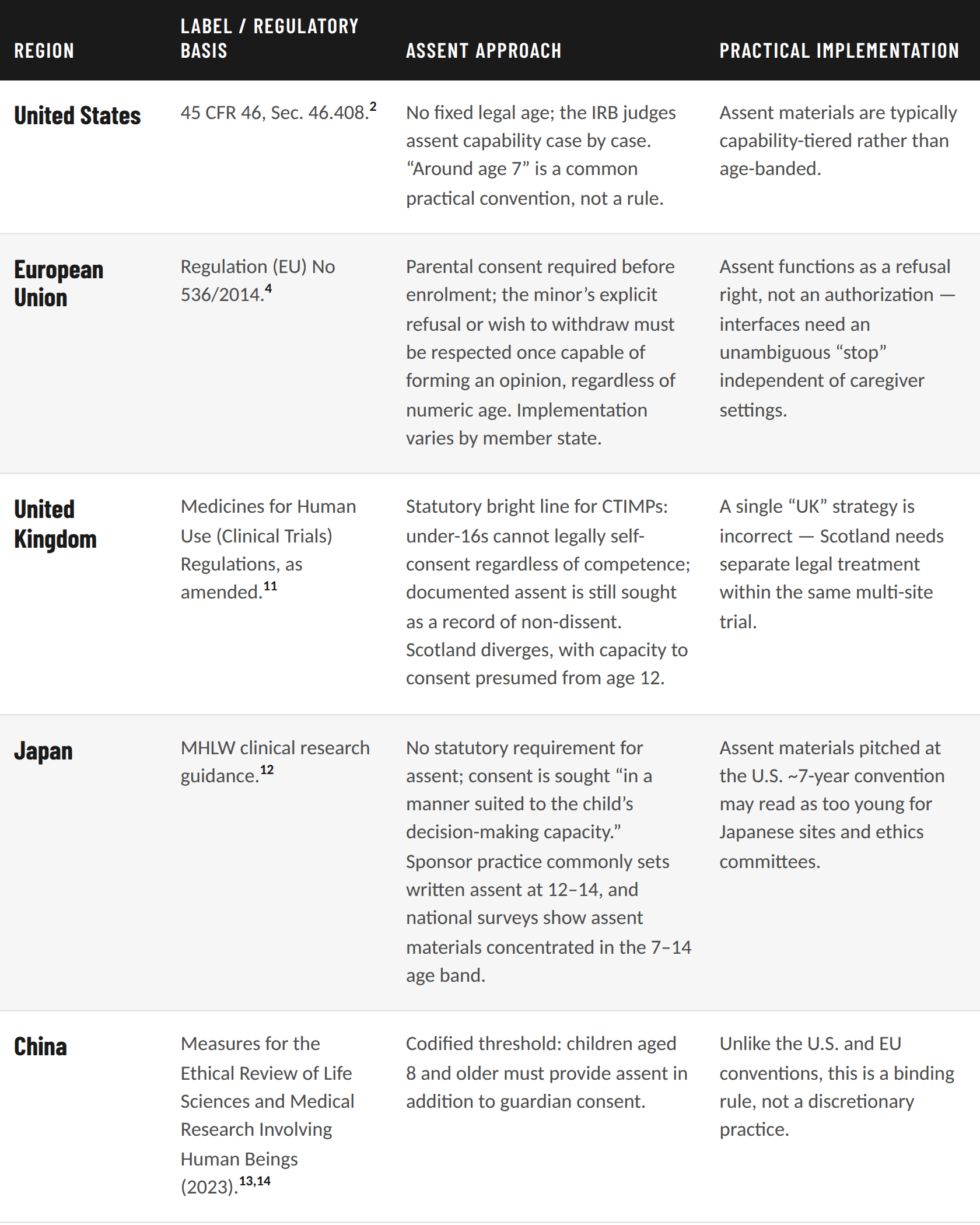
None of these frameworks agree on a numeric age, a legal mechanism, or even what assent is for: in the EU it functions as an enforceable refusal right; in the UK it is a documented courtesy with no legal force for CTIMPs; in China it is a codified requirement from a specific age. For a multinational obesity trial recruiting across some or all of these regions, the practical implication is to build assent and eCOA materials to the most protective, most specific requirement present in the recruiting countries, rather than defaulting to a single global template calibrated to the U.S. convention alone.
These requirements establish an essential floor, not a ceiling. A fully compliant consent and assent package can still fail an adolescent if the language relies on adult concepts, the everyday burden of participation is unclear, independent questions are discouraged, or caregiver access to sensitive data goes unexplained. In long-duration obesity studies, ethical adequacy must be judged throughout the participant journey, not only at enrolment.
Three interacting factors make ethical trial design particularly important in adolescent obesity research.
1. Emerging autonomy meets legal dependency
Adolescents can often understand research participation, articulate preferences, and weigh benefits and burdens — yet remain dependent on caregivers for legal authorization, transport, device access, and often medication administration. A caregiver may be highly motivated by concerns about the adolescent’s health, while the adolescent may feel uncertain about injections, assessments, or their weight becoming more visible to others. Neither perspective is wrong; the ethical task is ensuring caregiver motivation doesn’t displace the adolescent’s own preference, particularly where young people have experienced repeated, unsolicited discussions about body size or food. Affirmative agreement should never be inferred from attendance, task completion, or the absence of verbal resistance.
2. Weight stigma changes the meaning of participation
Weight stigma is a source of clinical, ethical, and methodological risk, not a peripheral concern. Weight-based victimization is highly prevalent among youth with overweight or obesity and is associated with depressive symptoms, low self-esteem, suicidal ideation, and poorer outcomes6,7,8,9; a bidirectional relationship exists between stigma and weight status in children. An adolescent who anticipates judgment may under-report eating patterns, body image concerns, mood, or missed doses, or answer in ways they think will be acceptable to a parent or coordinator. Weight-stigma-sensitive design — person-first language, avoiding a ‘fix the problem’ frame, and staff trained to recognize that reluctance or withdrawal may reflect embarrassment or pressure rather than nonadherence — protects both voluntariness and data validity.
3. Digital data collection creates new privacy exposures
Digital methods reduce travel burden and support more ecologically valid data, but they create privacy risks conventional data-security language doesn’t address. An adolescent may complete assessments on a shared family device, with notifications visible on a lock screen, or in a bedroom where a caregiver is present. The relevant question isn’t only whether data are securely transmitted — it’s whether the participant can realistically engage without unintended disclosure. Sponsors should ask whether the app name or notifications could disclose the condition or trial, whether the adolescent has reliable private device access, whether separate participant and caregiver credentials are required, whether session time-outs and authentication are age-appropriate, and which responses trigger safety follow-up and how that will be explained in advance.
Electronic informed-consent processes can meet regulatory requirements for parental permission and Pediatric assent, but electronic delivery alone doesn’t make them meaningful.10 The process must remain understandable, interactive, and appropriate to the participant’s maturity and circumstances.
Adolescent obesity trials collect participant-reported outcomes, caregiver or observer-reported outcomes, clinician assessments, and increasingly wearable-derived measures. These are not interchangeable: an adolescent’s experience of burden, body image, or mood is not simply a less reliable version of a caregiver’s account, and caregivers may notice things adolescents don’t recognize, recall, or wish to report. The aim is to preserve both perspectives without one overwriting the other — a dual-track participation model treats the adolescent and caregiver as connected but distinct study partners.
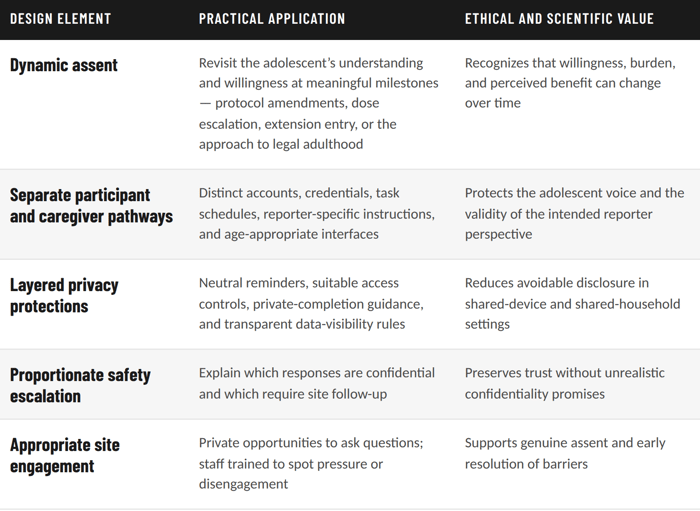
Separate pathways do not mean excluding caregivers, who remain essential contributors of observer-reported data and logistical support. The purpose is ensuring the adolescent has a private route to their own account. For example, if an adolescent completes a measure of treatment burden, the study should define whether caregiver assistance or co-viewing of answers is permitted — caregiver co-completion can undermine both the measure’s validity and the participant’s confidence that they can report honestly. This is where ethical design and measurement science converge.
Anti-obesity medicine trials may span 52 weeks or more, during which adolescents experience changes in school, friendships, body image, and treatment expectations. Assent obtained at baseline cannot be assumed to remain meaningful without ongoing engagement — though dynamic assent does not require repeating the full consent process at every visit. Study teams should identify natural checkpoints: a substantial protocol amendment, a transition to an open-label extension, a change in dose or administration, the introduction of new digital measures, a participant reaching legal majority (requiring their own consent), or a pattern of missed assessments suggesting disengagement.
These pressures are amplified in the current generation of incretin-based anti-obesity medicines, where injection anxiety, gastrointestinal side effects, and uncertainty about indefinite treatment or weight regain after discontinuation introduce burdens, and stigma dimensions, distinct from earlier lifestyle-intervention-era trials. The triggers above matter beyond ethics: if stigma-driven withdrawal disproportionately removes participants with worse psychosocial trajectories, the resulting missing data are unlikely to be missing at random, biasing the primary endpoint. Dynamic assent that surfaces concerns before a participant withdraws is therefore also a data-quality safeguard. Brief, age-appropriate digital tools — education modules, comprehension checks, reminders of voluntary participation — can support this engagement between visits without adding a compliance burden.
Family involvement is indispensable — caregivers enable participation through scheduling, travel, technology access, and emotional support, and their observer-report may be essential. But involvement should support, not displace, the adolescent.
Obesity trials touch deeply personal family considerations around food, body size, and prior treatment experience. Some families approach participation as a shared health goal; others carry conflict or markedly different expectations, and a technically compliant assent process may not reflect genuine voluntariness when the adolescent feels unable to disagree.
Practical safeguards include private time to ask questions without a caregiver present; plain-language reinforcement of the right to decline; a clear distinction between caregiver support and caregiver completion of self-report tasks; body-neutral, person-first staff training; and proportionate pathways for concerns raised at site or through participant-reported data. This respects caregivers as partners while keeping the adolescent central to research about their own body and experience.
The most effective adolescent obesity trials will treat participants as developing individuals rather than small adults, acknowledge family dependence without compromising emerging autonomy, and treat privacy and stigma as protocol and technology design features rather than background considerations.
For sponsors, sites, and technology partners, this means designing assent as an ongoing process rather than a single signature; building globally coherent but locally compliant pathways; applying privacy-by-design to eCOA, device access, and data visibility; and preserving distinct adolescent and caregiver perspectives through separately accessible data pathways.
These commitments do more than satisfy ethics committees — they create the conditions for authentic participation and credible, patient-centered evidence. In adolescent obesity trials, ethical design is not a parallel workstream to scientific rigor. It is a condition for obtaining credible evidence.

|
Dr. Figueroa is a Clinical Scientist with the eCOA Science Team at Signant Health, where she leverages her extensive expertise in electronic Clinical Outcome Assessments (eCOA) across diverse therapeutic areas, including oncology, dermatology, and infectious diseases. With over a decade of translational research experience, Dr. Figueroa is dedicated to advancing the field of clinical trials and improving patient outcomes through innovative methodologies and strategic insights. Her work at Signant Health focuses on integrating cutting-edge eCOA technologies to enhance the accuracy and reliability of clinical data, ultimately contributing to more effective and patient-centric healthcare solutions. |
 |
Joan Busner, PhD, has more than 35 years of experience as an academic psychiatric researcher and psychopharmacology principal investigator and founded and directed two university psychiatric clinical trials units. Dr. Busner served continuously on University Institutional Review Boards for 20 years. At Signant she has scientific and clinical responsibility for studies in mood, anxiety, pediatrics, and rare/orphan diseases. Dr. Busner is currently Affiliate Associate Professor of Psychiatry at Virginia Commonwealth University. |