Part of a 8-Chapter Series
Signant Health's clinical scientists and regulatory specialists work through the science behind pediatric and adolescent obesity trials. Read them in order, or start with the chapter closest to your work.

The September 2025 UNICEF report marking the moment global childhood obesity surpassed underweight for the first time in recorded history was not a statistical curiosity; it was an epidemiological inflection point decades in the making.
Understanding why this crisis is structural rather than cyclical matters not only for public health policy but for clinical research strategy: it determines whether investment in pediatric obesity trial infrastructure represents a durable opportunity or a speculative bet on a transient disease wave.
The evidence is unambiguous that it is the former.
The most compelling recent projections of childhood obesity come from the landmark March 2025 Lancet GBD Collaborators [GE1] study1, which modelled trajectories through to 2050 across 204 countries.
The findings are stark: without sustained, coordinated intervention, approximately 746 million children and adolescents will be overweight or obese by 2050. These projections incorporate demographic shifts, urbanization trajectories, dietary transition data, and physical activity pattern modelling, making them considerably more robust than earlier forecasts based on linear extrapolation of historical trends.
Three features of these projections are particularly relevant to clinical research planning:
Despite the scale of the epidemic documented above, the therapeutic options available to children and adolescents with obesity remain remarkably limited by comparison with the adult population. As of April 2026, six agents have received FDA approval for use in pediatric populations, but the limitations of those approvals matter as much as their existence.
The two GLP-1 receptor agonists with pediatric obesity labelling, liraglutide (Saxenda, approved December 2020) and semaglutide (Wegovy, approved December 2022), are both restricted to patients aged 12 years and above.
Orlistat and phentermine/topiramate ER (Qsymia) share the same ≥12-year threshold. Setmelanotide (Imcivree), a melanocortin-4 receptor agonist, occupies an important but narrow niche: it is approved from age six, but exclusively for rare specific monogenic obesity syndromes (POMC deficiency, LEPR deficiency, and Bardet-Biedl syndrome).
Mounjaro's December 2025 approval is for youth-onset T2DM (SURPASS-PEDS pathway), not obesity; the obesity label being contingent on SURMOUNT-ADOLESCENTS-2 data.
There is currently no approved anti-obesity medication (AOM) for obesity in any child under 12 years, and no dual incretin agent is approved for pediatric obesity.
The geographic dimension of this therapeutic gap deserves explicit recognition, and the access data within high-income markets offer a sobering starting point. In the United States, despite a substantial relative increase in the proportion of U.S. adolescents with obesity who were prescribed an AOM, <1% of eligible adolescents received an FDA-approved obesity medicine in 2023 [GE2]. 2
The picture in lower-resource health systems is more severe. The fastest-growing burden of pediatric and adolescent obesity is now in the regions where regulatory approval pathways, healthcare infrastructure, and medicine access are most constrained: North Africa and the Middle East, Latin America and the Caribbean, and Southeast Asia.
For clinical research, this inequity has a direct practical corollary: multinational trial designs that recruit predominantly from high-income academic medical centers risk generating efficacy and safety datasets that do not adequately represent the populations carrying the greatest future burden. As pediatric AOM trials expand in scale and ambition, the question of who is enrolled, and where, will carry increasing scientific, regulatory, and ethical weight.
Four forces converge to drive pediatric and adolescent AOM development:
Under the Pediatric Research Equity Act (PREA), sponsors of new drug applications for conditions affecting pediatric populations must include or commit to pediatric studies unless a waiver is granted. With obesity now a near-universal indication for novel incretin-class drugs, this is effectively a guarantee of pediatric trial activity across the entire pipeline. The EMA's Pediatric Investigation Plan (PIP) requirement operates in parallel in Europe. The FDA's January 2025 updated draft guidance on obesity drug development, which includes specific pediatric endpoint and PRO considerations, signals ongoing regulatory investment in this framework.
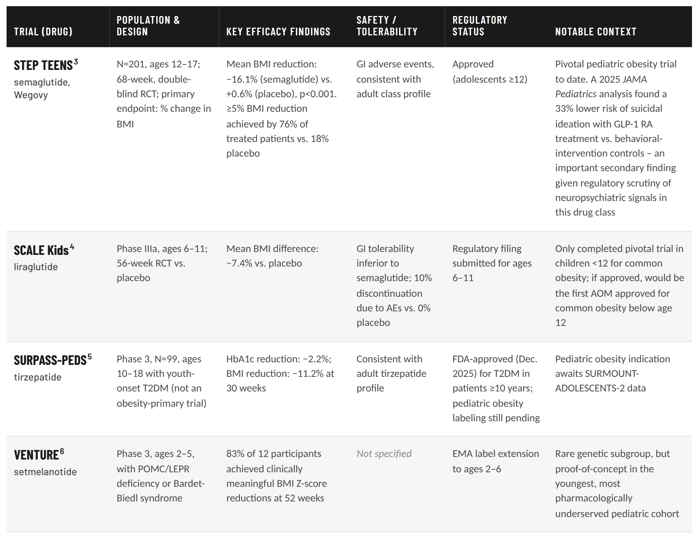
The two highest-priority active trials: SURMOUNT-ADOLESCENTS-2 (primary completion October 2026; the nearest major pediatric obesity data readout; tirzepatide for obesity in adolescents aged 12-17) and STEP-Young (NCT05726227; semaglutide; ages 6-18; primary completion approximately 2027; the broadest age range in the current pipeline and potentially the trial that will define the sub-12 semaglutide landscape).
The oral formulation development trajectory: Oral semaglutide received FDA approval for adults in December 2025, and a pediatric obesity program is anticipated. Orforglipron, Eli Lilly's oral small-molecule GLP-1 RA, with adult approval anticipated in 2026, carries PREA obligations for pediatric obesity development. This shift toward orally administered agents is particularly relevant in the pediatric context, where injection-related barriers are a meaningful determinant of adherence and recruitment.
There are currently approximately 200 obesity assets in global development, each of which, if successfully developed in adults, will carry PREA obligations for pediatric investigation. The pediatric obesity trial pipeline is a regulatory certainty extending well into the 2030s.
The pediatric obesity clinical trial landscape has undergone a dramatic transformation in the space of five years. The evidence base that did not exist in 2019 now includes pivotal RCTs demonstrating BMI reductions of 16% in adolescents, proof of concept in children as young as two years, and an active pipeline of trials that will generate label expansions down to younger age cohorts and across new mechanism classes through the rest of this decade.
The remaining scientific questions: how to measure benefit optimally in growing children, how to monitor safety across developmental stages spanning pre-pubertal childhood to late adolescence, how to retain participants in trials lasting 52-72 weeks; are the substance of the Signant Health’s scientific strategy. Addressing them rigorously is what will determine whether this generation of medicines reaches the children who need them.

|
Dr. Graham C Ellis, MD is a Clinical Vice President at Signant Health. A specialist physician with more than 25 years of experience in diabetes, endocrinology, and metabolic disease, he has served as Principal Investigator on more than 150 international clinical trials. Dr. Ellis previously served as Executive Director of Medical Science and Strategy at PPD, the clinical research business of Thermo Fisher Scientific, and is a founding member of the Centre for Diabetes and Endocrinology (CDE). |